We size the robot to the pipe, not the pipe to the robot.
We run a standing fleet of five robotic platforms out of Olympia, Washington, each matched to a different access problem rather than one truck trying to do everything. Beyond that envelope we configure from the full manufacturer platform line — bringing in the chassis and nozzle package the diameter calls for, up to 120" pipe — and our own certified crews operate it either way.
A service van, not a vacuum truck.
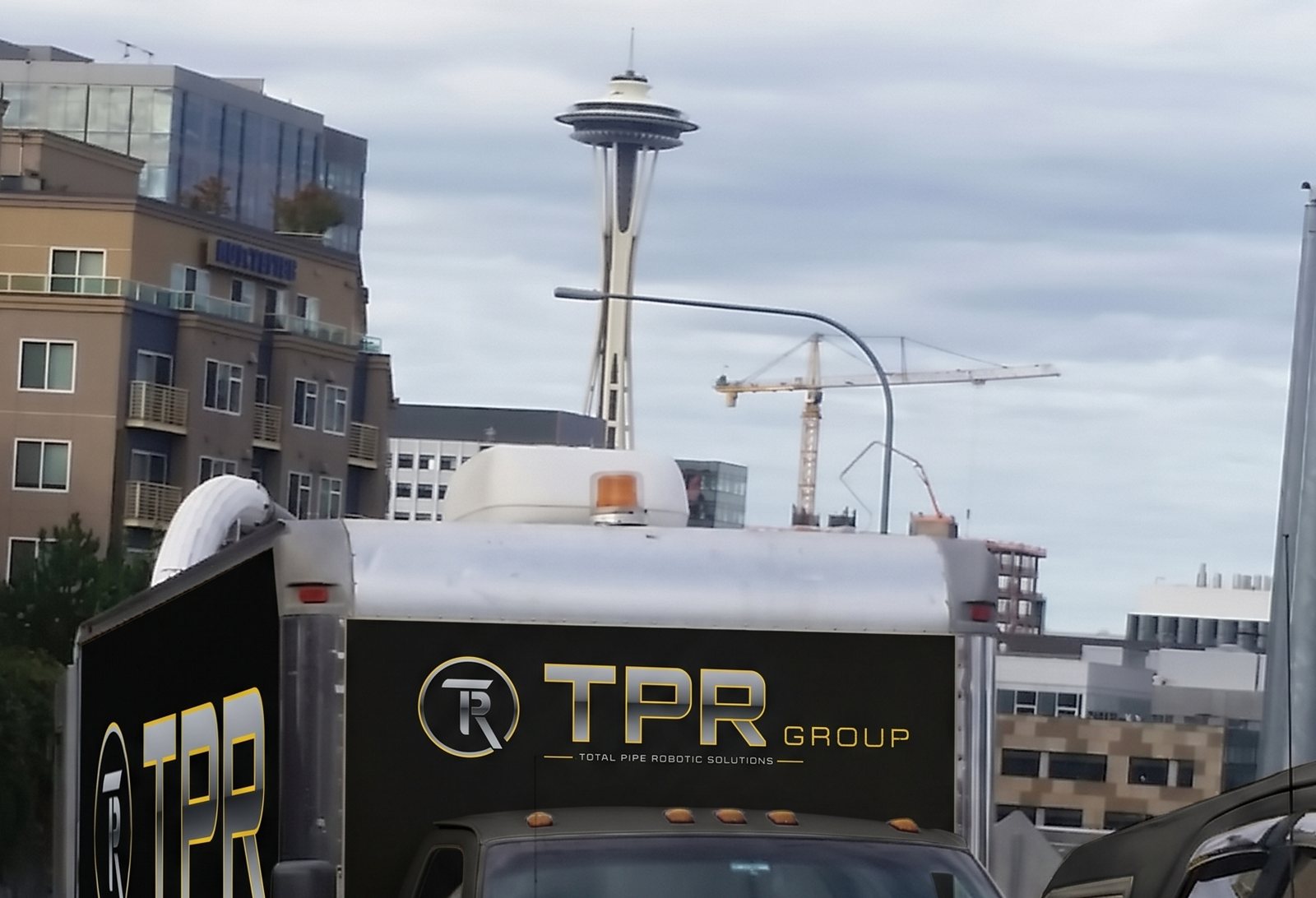
Our crews arrive in a service van carrying cameras, crawlers, jetting heads, hose reels, power and data — configured around the work rather than around a chassis. A van parks in a garage, fits under a height restriction, drives onto a campus without a permit, and does not announce to every tenant in the building that something is wrong with the plumbing.
There are two kinds in the fleet, and the difference matters when you are scoping a job. The UHP cutting van is turn-key: the cutting robot, its control systems, reels and power are built into the vehicle and travel as one unit, which is what makes a 40,000 psi deployment a drive rather than a setup. The portable platforms — the mainline inspection system and the multi-function traction robot — adapt into that same van when the work is local, and case up and ship when it is not.
It also changes the economics. On a great many jobs a two-person crew and a service van can clean, inspect, map and cut on one mobilization. That is one mobilization instead of three, and it is the reason our scope on a difficult site often comes in under a conventional bid that needed a jet truck, a CCTV truck and a cutting crew on separate days.
Crews deploy out of Olympia, Washington, covering the Pacific Northwest.
Beyond that, two platforms travel without the van at all. We call it the flyaway service: the mainline inspection system and the multi-function traction robot break down into hard transit cases and ship, the crew flies, and the van, vacuum truck, UHP pump trailer and water supply are arranged in the local market before anyone lands. The robots and the certified operators are what we bring. Everything with wheels on it we rent.
Two kinds of van
Combined fleet envelope
Every pipe in the system — 3" to 120".
No single robot covers a whole network. Five cover ours, and the overlap is deliberate, so there is always a platform that reaches the asset rather than one that nearly does. Past that envelope the platform line keeps going: the same manufacturers build larger chassis and nozzle packages, and we bring in the size the job needs. Hover any bar for what that platform brings.
Scale is logarithmic so the small-diameter end, where most building and lateral work sits, stays readable alongside 48" mains and large-diameter culvert. Solid bars are equipment we own and operate today. Dashed extensions are the published envelope of the same platform line — we quote them with lead time and a named source, never as in-stock capacity.
Diameter is only half the question.
The chart above says how big. This says what it is. Asset type decides which platform goes in; material decides how hard we are allowed to hit it; shape decides whether a wheeled crawler is any use at all. Send us all three and we can scope a job from an email.
What the line does
- Gravity sanitary mains, trunk sewers and interceptors
- Storm drains, culverts and highway cross-drains
- Force mains and pressure sewer, taken out of service
- Service laterals, public side and private side
- Building stacks, risers, roof drains and kitchen waste lines
- Process drains, chemical and effluent lines
- Cooling water loops and condenser lines
- Raw water intakes, outfalls and penstocks
- Manholes, wet wells, drop structures and siphons
What it is made of
- Vitrified clay
- Reinforced and unreinforced concrete
- Corrugated metal, including invert-loss assessment
- Ductile iron and cast iron
- Steel and lined steel
- PVC, HDPE and other thermoplastics
- Brick and masonry
- CIPP and failed or delaminated liner
- Asbestos cement
Material is why our pumps are adjustable. Roots and grease come off a clay pipe or a liner at the bottom of the range; set concrete needs the top of it. A fixed-pressure unit has to pick one.
What section it runs in
- Round, 3" to 54" standing, configured to 120"
- Egg-shaped and arch sections
- Box culvert, square and rectangular
- S-shaped and compound runs
- Vertical stacks and risers, to 164 ft
- Submerged sections, to 10 m
Non-circular is where most crawlers stop. Our traction platform braces against the wall rather than riding the invert, so a box section is a normal day.
Asbestos cement is on that list deliberately. AC pipe is still in the ground across most older systems, and plenty of contractors decline the asset rather than deal with it. Inspecting and cleaning it is routine for us — a camera pass and a cleaning pass do not disturb the pipe wall. The line is cutting: work that cuts into AC pipe is regulated and runs under an abatement protocol, so we scope that separately instead of burying it in a cleaning ticket. Potable water mains are not in our scope today — the disinfection, certification and equipment-dedication requirements are a separate discipline, and we would rather tell you that now than learn it on your project.
SCHEDULE
Need the model-level detail?
Manufacturers, model numbers, serial-level specifications and certification records are in our capability statement, provided with any proposal or on request. Specifying engineers and procurement officers — ask and we will send it the same day.
What's in the vans
Each platform exists because it solves something the others can't. We own and run all of them, which is why we can tell you honestly when a job doesn't need the expensive one — and when a job needs a chassis outside this list, we say that too and rent it direct from the manufacturer.
AI-assisted mainline inspection platform
Primary mainline inspection, and the platform behind our AI-assisted coding. 40 lb man-portable system, 6"–48" pipe, 2,000 ft reach, 4K video with 360° views, inch-level odometry, built-in LTE/5G straight to the cloud. AI streamlines defect identification; a NASSCO-certified coder verifies every observation. Multi-sensor add-ons measure ovality, diameter, joint gap and material loss on the same run.
Clean-and-inspect platform
Steerable jetting head with Full HD live camera on one Kevlar-reinforced hybrid hose. Cleans and inspects in a single pass — our building platform for commercial, mid-rise and high-rise stacks. 3" minimum through 45° bends, camera inspection to 16", 100–265 ft hose rated to 4,350 psi.
UHP cutting robot — 10,000 to 40,000 psi
Ultra-high-pressure water cutting across 8"–48", with larger-diameter configurations available. Pressure adjustable across the full range at the touch of a button, accurately steerable nozzle, CCTV module on the head. Concrete, grout, calcium, tuberculation, failed liner, protruding taps and roots — no mechanical blade touches the host pipe.
Multi-function traction robot — seven tools, one chassis
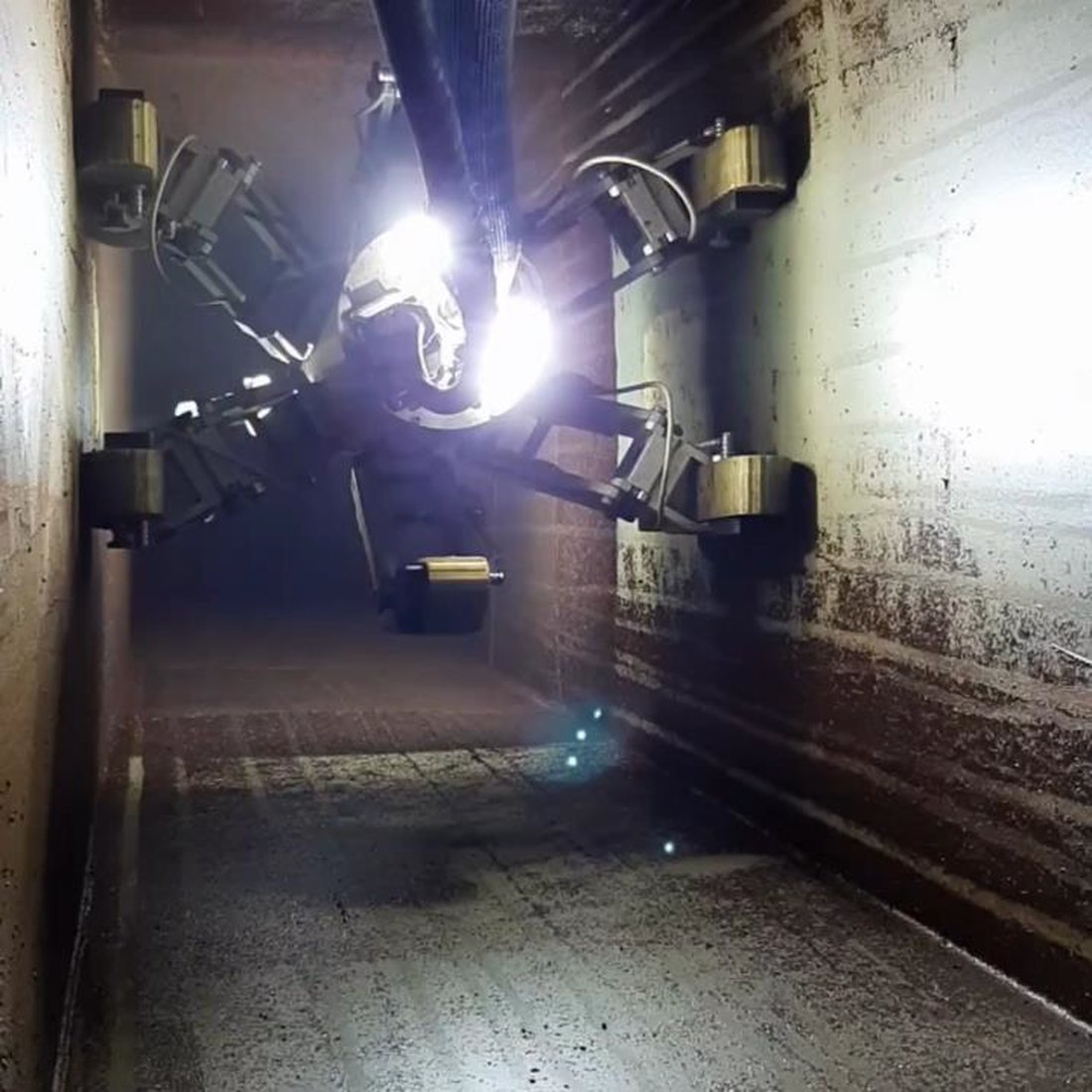
Self-propelled hose-fed traction robots with front and rear cameras, covering 8" to 54" with extension arms and running over 4,900 ft in a single deployment. Round, square, rectangular, S-shaped and vertical piping. It inspects, UHP cleans, abrasive cleans, dry-ice cleans, laser profiles, measures remaining wall thickness and rehabilitates with epoxy coating — one robot in the pipe doing what normally takes four contractors and four mobilizations.
3D-mapping push camera
Push inspection with a sensor in the camera head that records the pipe route in three dimensions — XYZ coordinates travelling either direction, real-time site plan, width, length and elevation. Our tool for laterals, service lines and vertical building stacks with no usable as-builts.
Trailer-mounted jetters
Self-contained water supply for sites with no hydrant or building supply — 12 gpm at 3,000 psi off a 200-gallon tank with wireless remote, towed behind a service van so one crew runs pump and robot together.
Vacuum trucks and combination units
Conventional vacuum trucks and jetting units are in the fleet because a great deal of this work genuinely needs them — flushing a line end to end, moving volume, lifting sediment and debris out and hauling it off site. Nothing else does that job, and on a surcharged main or a heavy sediment load a robot would be the wrong tool and the wrong price. They also feed the robotic work: on a site with no hydrant and no building supply, the truck or the trailer jetter is where the water comes from. Having both is what lets the scope follow the asset instead of the equipment.
One robot in the pipe. Seven tools on it.
Our traction platform is the reason a difficult asset does not need four contractors on four different days. The same chassis changes tooling and keeps working — 8" to 54" with extension arms, over 4,900 ft in a single run, in round, square, rectangular, S-shaped and vertical structures.
Inspect
Front and rear industrial colour cameras recording as the robot works, so the condition record and the work happen on the same pass.
UHP clean & cut
Paired with a matched ultra-high-pressure pump unit for work to 40,000 psi — concrete, grout, calcium, tuberculation and failed liner.
Abrasive clean
Media-assisted removal and surface preparation for the deposits and coatings that water pressure alone will not lift cleanly.
Dry-ice clean
Non-abrasive and residue-free, for substrates and process lines that cannot take grit or standing water — the medium sublimates rather than needing recovery.
Laser profile
Measured pipe geometry — deformation, ovality and bore loss — captured as numbers a rehabilitation design can be specified against, not as an estimate from a camera.
Wall-thickness measurement
Remaining wall measured from inside the pipe, in place. The number that decides repair against replacement — and the one an integrity program is usually missing.
Epoxy rehabilitation
Protective epoxy coating applied in place, so the sequence from assessment to clean to repair can run end to end without a single excavation.
Clean it, see it, measure it, cut it, gauge what is left of the wall, coat it — and check the result — without the robot ever leaving the pipe.
The equipment, where it actually works.
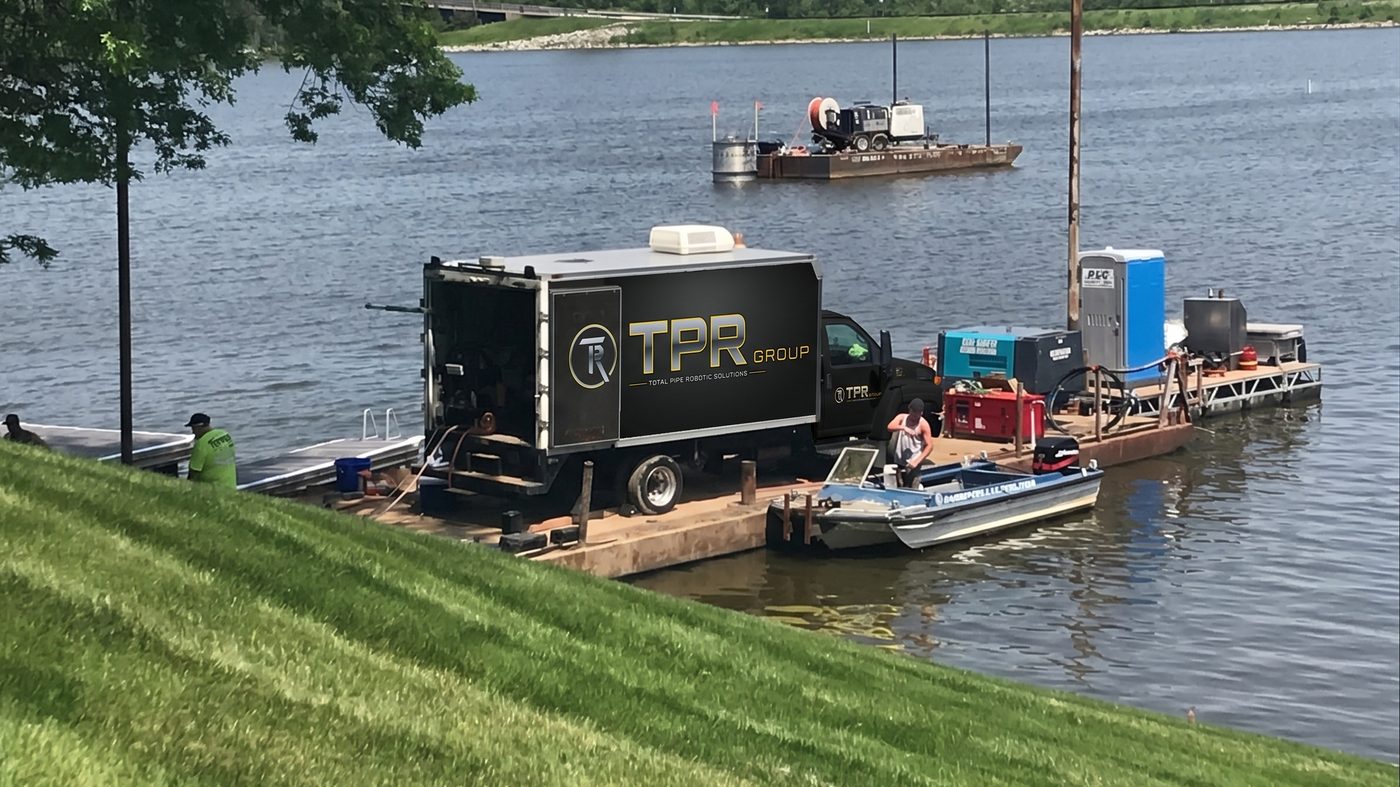
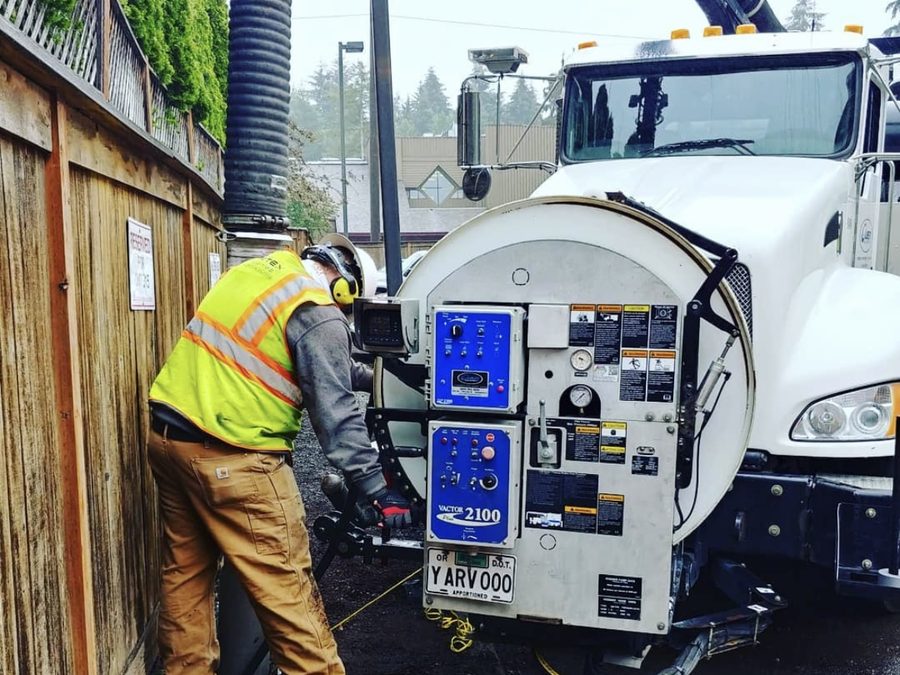
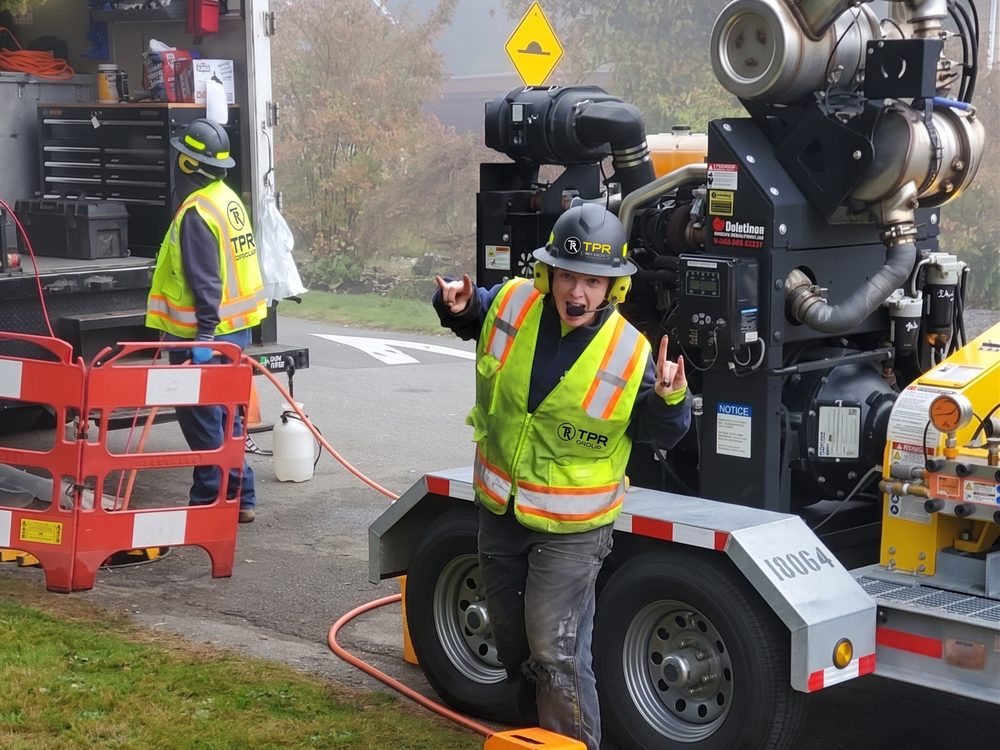
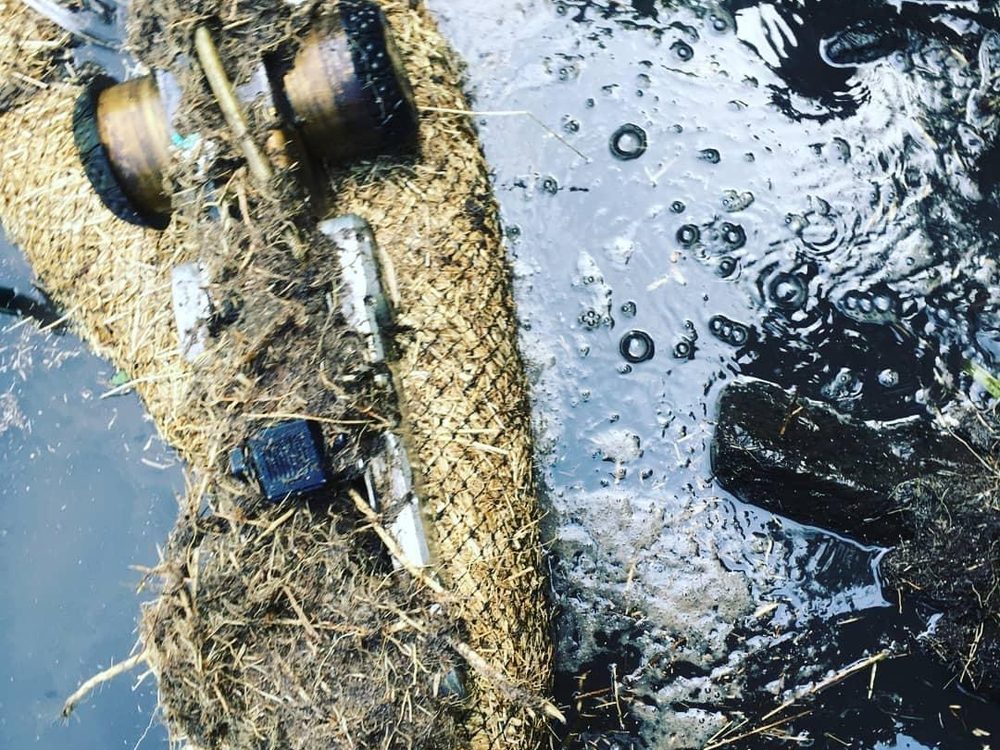
Project photography from work performed by our crews and by our leadership’s prior companies. Client-identifying detail removed.
One asset class, four very different access problems.
A building stack, a service lateral, a live main and an off-road easement each defeat a different piece of conventional equipment. We carry a platform matched to each.
Building stacks & risers
A jet-driven, steerable head with a Full HD camera on one hose. Cleans and inspects vertical stacks in occupied mid- and high-rise buildings in a single pass.
Laterals & service lines
A push camera that maps as it goes, building an XYZ pipe route as the head travels — so you get a mapped lateral, not just footage.
Mains, 6" to 48"
A man-portable 4K platform with AI-assisted coding for inspection, UHP cutting robots for obstruction removal, and multi-function traction robots for heavy cleaning in large-diameter and non-circular pipe.
Easements & no-access runs
A 40 lb system two people carry past the gate, the treeline or the security perimeter. No truck, no road, no excavation.
Ask us which platform your job needs.
We own the standing fleet and rent the rest from our manufacturers, so we have no reason to sell you the wrong one. Describe the asset and we will tell you what actually fits.